Skink Meaning & Definition : What Is a Skink and Why Does It Matter?
Introduction
You’ve spotted a shiny, smooth-scaled lizard darting through the leaves — and now you’re wondering what it actually is. Most people mistake skinks for snakes or common lizards, but they’re something entirely different. The skink meaning goes deeper than just a name. These reptiles are among the most common lizard families on Earth due to their diverse range of behaviors, rich biological identity, and global prevalence. Here’s everything you need to know.
What Is a Skink? The Complete Skink Definition Explained
A skink is a lizard belonging to the family Scincidae, which is one of the largest lizard families in the world. The skink meaning, at its core, refers to any member of this diverse reptile group — currently comprising over 1,500 recognized species spread across six continents.
Unlike many other lizards, skinks have:
- Smooth, overlapping scales that give them a glossy, almost metallic appearance
- Reduced or absent limbs in some species
- Cylindrical bodies built for burrowing and ground movement
- Quick, fluid movement that often gets confused with snake behavior
The word “skink” traces back to the Latin word scincus and the Greek word skinkos, both historically used to describe a type of lizard native to desert regions of North Africa. Ancient writers like Pliny the Elder documented skinks as medicinal animals — quite a reputation for a creature most people have never heard of.
Skink Meaning in Different Contexts: Science, Language, and Culture
The skink meaning shifts slightly depending on where you encounter the word.
In biology and herpetology, a skink is a formally classified reptile within the order Squamata, suborder Scincomorpha, and family Scincidae. This is the most precise and widely accepted definition.
In everyday language, people use “skink” loosely to describe any small, fast-moving lizard they see near gardens, woodpiles, or forest floors — though not all of those sightings are technically skinks.
In historical and cultural contexts, skinks appear in ancient Egyptian medicine, Roman natural history texts, and various indigenous traditions. They were considered powerful animals with both symbolic and practical significance.
In modern pop culture, the skink occasionally appears in children’s books, wildlife documentaries, and even as a beloved exotic pet — especially the Blue-Tongued Skink, which has its own massive online fanbase.
Complete Skink Identification Table
| Feature | Description |
| Family | Scincidae |
| Order | Squamata |
| Total Species | 1,500+ |
| Average Length | 3 inches to 14 inches (varies by species) |
| Body Shape | Elongated, cylindrical |
| Scale Type | Smooth, overlapping, often shiny |
| Limb Presence | Full limbs, reduced, or absent |
| Lifespan | 5–20 years depending on species |
| Diet | Omnivorous (insects, fruits, small vertebrates) |
| Reproduction | Oviparous or viviparous |
| Distribution | Global — all continents except Antarctica |
| Most Famous Species | Blue-Tongued Skink, Five-Lined Skink |
| Threat Level to Humans | Non-venomous, generally harmless |
| Conservation Status | Varies — many are of Least Concern; some endangered |
Top Skink Species You Should Know About
Understanding the skink meaning becomes far more vivid when you look at individual species. The family Scincidae is astonishingly diverse.
Blue-Tongued Skink (Tiliqua scincoides)
This is arguably the most recognized skink in the world. Native to Australia and Indonesia, the Blue-Tongued Skink flashes its bright blue tongue as a defense mechanism to startle predators. It’s also a popular pet thanks to its calm temperament and manageable size.
Five-Lined Skink (Plestiodon fasciatus)
Common across eastern North America, this species is identified by five distinctive yellow or white stripes running down a dark body. Young individuals sport a vibrant blue tail that fades with age.
Sandfish Skink (Scincus scincus)
This North African and Middle Eastern species is famous for its ability to “swim” through sand. Its specialized body and scales allow it to move beneath loose desert sand as if swimming — a remarkable adaptation that scientists have studied for bio-inspired robotics research.
Emerald Tree Skink (Lamprolepis smaragdina)
Found across Southeast Asia and Pacific islands, this arboreal skink is prized for its stunning green coloration. Unlike most skinks that prefer ground-level living, this species thrives in tree canopies.
Pink-Tongued Skink (Cyclodomorphus gerrardii)
Another Australian native, the Pink-Tongued Skink is often confused with the Blue-Tongued Skink but has a distinctly pink tongue and a more slender body. It’s primarily nocturnal and prefers humid, forested environments.
Schneider’s Skink (Eumeces schneiderii)
Native to North Africa, the Middle East, and Central Asia, this species was the original “skink” described by ancient Greek and Roman writers. It was used historically in traditional medicine.
Where Do Skinks Live? Habitat and Geographic Distribution
Skinks are extraordinary survivors, and their habitat range proves it. You’ll find them on nearly every continent and in almost every ecosystem type.
Tropical Forests: Many species in Southeast Asia and Central America live in dense, humid jungle environments, using leaf litter as cover.
Deserts: The Sandfish Skink is a masterclass in desert adaptation. It avoids daytime heat by burrowing beneath sand and hunting at dusk.
Grasslands and Savannas: Sub-Saharan African skinks thrive in open grasslands where insects are plentiful and ground cover provides protection.
Suburban Gardens: In North America and Australia, skinks regularly appear in backyard gardens, under rocks, and along fence lines — making them one of the most commonly spotted urban wildlife species.
Coastal Areas: Some species are adapted to sandy coastal zones, where they bask on rocks and hunt near the shoreline.
The global spread of skinks is a direct result of their highly adaptable biology, efficient reproduction, and versatile diet — three factors that allowed this family to colonize almost every land habitat available.
How Do Skinks Behave? Activity Patterns and Defense Strategies
Skink behavior is one of the most fascinating aspects of understanding the full skink meaning. These lizards are far more intelligent and complex in their behavior than most people expect.
Daily Activity:
The majority of skink species are diurnal, meaning they are active during the day.They spend mornings basking to regulate body temperature and then hunt during the warmest parts of the day. A few species, like the Pink-Tongued Skink, are nocturnal.
Defense Mechanisms:
Skinks have developed several clever ways to protect themselves from predators:
- Tail autotomy — Many skinks can shed their tail when grabbed. The detached tail wriggles on the ground, distracting the predator while the skink escapes. The tail grows back over weeks or months.
- Burrowing — Several species disappear underground instantly when threatened.
- Camouflage — Many species blend seamlessly into leaf litter, bark, and soil.
- Tongue display — The Blue-Tongued Skink’s dramatic blue tongue flash startles predators effectively.
Social Behavior:
Most skinks are solitary animals, but some species show surprising social complexity. Research published in herpetological journals has documented family group living and even basic forms of parental care in certain skink species — particularly among viviparous (live-bearing) types.
What Do Skinks Eat? Diet and Feeding Habits
Skinks are primarily opportunistic omnivores, though the exact diet varies by species and habitat.
Common food sources include:
- Insects (beetles, crickets, grasshoppers, moths)
- Spiders and other arachnids
- Earthworms and snails
- Small lizards and frogs
- Bird eggs (in larger species)
- Berries, plant matter, and fallen fruit
- Flower nectar (in some Pacific island species)
The Blue-Tongued Skink is well-known for eating garden snails, making it a natural pest controller in Australian gardens. Some larger species like the Prehensile-Tailed Skink (Corucia zebrata) are almost entirely herbivorous — eating leaves, fruits, and vegetables.
Young skinks tend to be more insectivorous, while adults often shift toward a more varied, omnivorous diet as their jaw strength increases.
Skink Reproduction: How Do Skinks Have Babies?
One of the most scientifically interesting aspects of skink biology is their dual reproductive strategy. Some species lay eggs (oviparous), while others give birth to live young (viviparous). A few species even occupy the middle ground — retaining eggs inside the body until just before hatching (ovoviviparous).
Key reproduction facts:
- Five-Lined Skinks lay clutches of 4–14 eggs and actively guard the nest — an unusual behavior for lizards
- Blue-Tongued Skinks give birth to 10–25 live young after a 3–5 month gestation period
- Prehensile-Tailed Skinks are one of the few lizard species to give birth to a single offspring and care for it over an extended period
- Most hatchlings are fully independent from birth, receiving no parental guidance
This reproductive flexibility is one major reason the family Scincidae has achieved such extraordinary global diversity.
Are Skinks Dangerous? Safety Facts Every Person Should Know
This is one of the most searched questions related to skink meaning, and the answer is straightforward: No, skinks are not dangerous to humans.
Here’s the complete picture:
- Skinks are non-venomous — no skink species produces venom
- They may bite defensively if grabbed or cornered, but the bite is typically harmless and rarely breaks skin in smaller species
- Larger species like the Blue-Tongued Skink can deliver a firm bite with their strong jaws, which may cause minor pain but no lasting injury
- Skinks do not carry diseases that pose significant risk to healthy humans, though basic hygiene after handling any wild reptile is always recommended
- They are beneficial to gardens — eating pest insects, slugs, and snails
The Centers for Disease Control and Prevention (CDC) recommends washing hands thoroughly after handling any reptile as a general hygiene precaution, not because skinks are uniquely dangerous.
Skinks as Pets: What You Need to Know Before Getting One
The demand for pet skinks has grown significantly over the past two decades. Understanding the skink meaning in a captive context means looking at care requirements, temperament, and ethical sourcing.
Most popular pet skink species:
| Species | Temperament | Size | Experience Level |
| Blue-Tongued Skink | Calm, handleable | 18–24 inches | Beginner-friendly |
| Schneider’s Skink | Active, curious | 12–16 inches | Intermediate |
| Fire Skink | Shy, colorful | 12–15 inches | Intermediate |
| Emerald Tree Skink | Alert, active | 8–12 inches | Intermediate |
| Pink-Tongued Skink | Docile, nocturnal | 14–18 inches | Beginner-friendly |
Basic care requirements:
- Enclosure: Minimum 40-gallon tank for most species
- Temperature: Basking spot of 90–100°F with ambient temperature of 75–85°F
- Lighting: UVB lighting is essential for calcium metabolism
- Diet: Balanced mix of insects, vegetables, and occasional fruit
- Humidity: Varies by species — research your specific type
Always source pet skinks from reputable breeders rather than wild collection. Wild-caught animals experience extreme stress and often carry parasites. Organizations like the Association of Reptile and Amphibian Veterinarians (ARAV) provide guidance on ethical reptile keeping.
Skink Conservation: Which Species Are Under Threat?
While many skink species thrive, a significant number face serious conservation pressure. Habitat destruction, invasive species, and the illegal pet trade have pushed several species toward endangered status.
Notable conservation concerns:
- Cunningham’s Skink (Egernia cunninghami) — Vulnerable due to habitat fragmentation in Australia
- Solomon Islands Skink (Corucia zebrata) — Listed as Appendix II under CITES due to collection pressure
- Gongylus ocellatus — Declining across parts of the Mediterranean due to agricultural expansion
- Lipinia noctua — Island populations in the Pacific face threats from introduced predators like rats and cats
The IUCN Red List tracks skink species conservation status globally, and conservationists from institutions like the Australian Reptile Park actively work on captive breeding programs for threatened species.
You can support skink conservation by:
- Purchasing only captive-bred pets
- Reporting illegal wildlife trade to authorities
- Supporting habitat conservation organizations
- Never releasing pet reptiles into the wild
Skink Meaning in History, Mythology, and Traditional Medicine
The historical dimension of skink meaning is surprisingly rich. Long before herpetology existed as a science, humans were documenting and using skinks.
Ancient Egypt: The Egyptian Sand Skink appeared in hieroglyphic art and was associated with the desert landscape. Dried skink preparations appeared in ancient medical texts.
Greek and Roman Antiquity: The physician Dioscorides and the naturalist Pliny the Elder both wrote about Schneider’s Skink (the original scincus) as a remedy for various ailments — from treating kidney problems to being used as an aphrodisiac. These claims have no modern scientific support, but they reflect how deeply embedded skinks were in Mediterranean culture.
Indigenous Australian Traditions: Several Aboriginal Australian cultures incorporated skinks into their Dreamtime stories and land management knowledge. The presence or absence of certain skink species was used as an ecological indicator of land health.
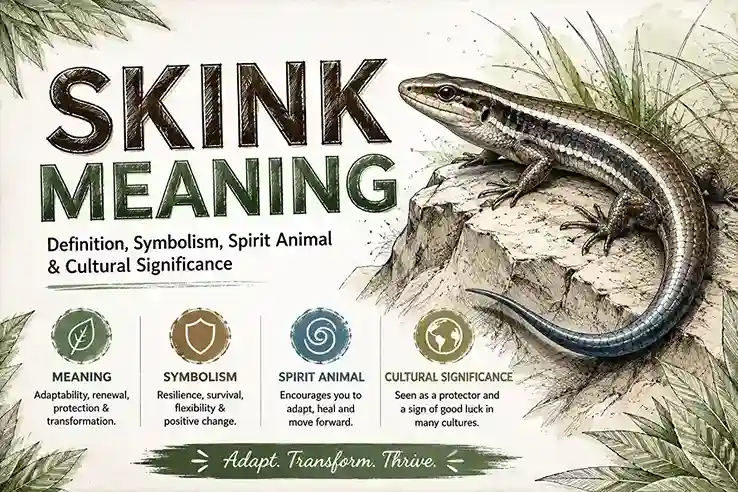
Modern Symbolism: In contemporary culture, skinks appear as symbols of adaptability, quick thinking, and resilience — qualities that align well with the animal’s actual biology.
Frequently Asked Questions About Skink Meaning
What exactly does “skink” mean?
A skink is a lizard belonging to the family Scincidae, characterized by smooth scales, a cylindrical body, and worldwide distribution across more than 1,500 species.
Are skinks the same as lizards?
Yes, all skinks are lizards, but not all lizards are skinks.
Do skinks bite humans?
They can bite defensively, but skink bites are rarely harmful.
Can skinks lose and regrow their tails?
Yes, many skink species practice tail autotomy and can regrow a new tail.
Are skinks good pets for beginners?
Several skink species make excellent starter reptiles, especially the Blue-Tongued Skink.
Where do skinks live in the wild?
Skinks live on every continent except Antarctica, thriving in deserts, forests, grasslands, coastal areas, and suburban gardens.
The Skink’s Place in a Healthy Ecosystem
Skinks play genuinely important ecological roles that extend well beyond their individual biology.
As predators, they control insect and invertebrate populations — reducing crop-damaging pests and garden nuisances like slugs and beetles.
As prey, skinks serve as a critical food source for hawks, foxes, snakes, cats, and larger reptiles. Remove skinks from an ecosystem, and multiple predator populations would feel the impact.
As seed dispersers, fruit-eating skink species carry seeds through their digestive systems and deposit them across wide areas — contributing to plant diversity and forest regeneration.
A 2019 study published in Biological Conservation found that skinks on island ecosystems were critical to maintaining plant diversity by dispersing seeds that other animals couldn’t. Their quiet, unassuming presence supports entire food webs.
Understanding the Skink Meaning Changes How You See the Natural World
The skink meaning reaches far beyond a simple dictionary entry. These animals connect ancient history to modern science, inhabit every corner of the planet, play irreplaceable roles in ecosystems, and present real opportunities for conservation action.
Whether you spotted one darting through your garden, found one listed in a wildlife guide, or stumbled across the word in an old text — the skink is worth knowing. It’s not a snake. It’s not a generic lizard. It’s a member of one of the most successful reptile families that ever evolved, shaped by millions of years of adaptation into a form that’s both beautifully simple and endlessly complex.
The next time you see one basking on a warm rock or slipping under a leaf pile, you’ll know exactly what you’re looking at — and why it matters.
Want to go deeper? Share this article with someone who’s ever mistaken a skink for a snake, leave a comment below with your own skink encounter, or explore our related guides on reptile identification and backyard wildlife. Your curiosity is how real conservation awareness starts.
External Sources Referenced:
- IUCN Red List of Threatened Species — iucnredlist.org (Skink conservation status data)
- Centers for Disease Control and Prevention — cdc.gov (Reptile handling hygiene guidelines)
- Biological Conservation Journal, 2019 — Seed dispersal study on island skink populations
- Association of Reptile and Amphibian Veterinarians — arav.org (Ethical reptile keeping standards)
- Pliny the Elder, Naturalis Historia — Historical documentation of skinks in ancient natural history