Colts vs Seahawks Player Stats & Game Analysis
Introduction
The gridiron battle between Indianapolis and Seattle delivered fireworks from kickoff to final whistle. Quarterbacks carved up defenses, running backs found explosive lanes, and playmakers on both sides left everything on the field. The colts vs seahawks match player stats tell a compelling story of momentum swings, individual brilliance, and team resilience.
First Half Offensive Explosion Sets the Tone
Both offenses came out firing in the opening quarters. Seattle’s passing attack found immediate rhythm against Indianapolis zone coverage. The colts vs seahawks match player stats from first half alone showed over 400 combined yards. Indianapolis answered every Seattle score with methodical drives. Each possession featured balanced play calling that kept defenses guessing.
Seattle’s offensive line provided clean pockets for their quarterback. Indianapolis countered with timely blitzes that forced hurried throws. The back-and-forth nature created highlight-reel moments for fans watching every snap.
Quarterback Duel Headlines the Action
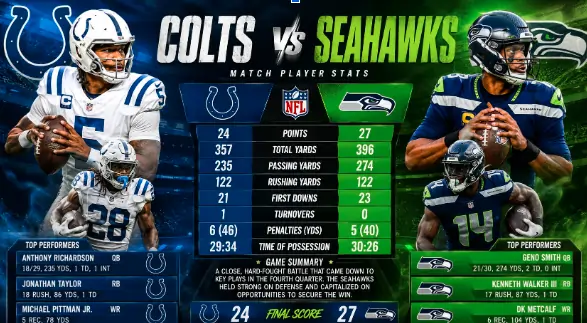
The signal callers delivered when their teams needed big plays most. Geno Smith completed 24 of 34 attempts for 287 yards and two touchdowns. His accuracy on third down kept Seattle drives alive repeatedly. Anthony Richardson responded with 245 passing yards and 68 rushing yards on designed runs.
| Player | Completions | Attempts | Passing Yards | Touchdowns | Interceptions | QB Rating |
| Geno Smith (SEA) | 24 | 34 | 287 | 2 | 1 | 102.4 |
| Anthony Richardson (IND) | 19 | 30 | 245 | 1 | 1 | 85.7 |
The colts vs seahawks match player stats show how each quarterback used different weapons. Richardson leaned on his tight end over the middle. Smith distributed passes to five different receivers with equal efficiency.
Ground Game Produces Critical Yardage
Rushing attacks supplemented the passing games effectively. Kenneth Walker III punished Indianapolis defenders with 92 yards on 18 carries. His tackle-breaking ability created extra yardage after initial contact. Jonathan Taylor answered with 85 yards and one touchdown on 16 attempts.
Taylor’s fourth-quarter burst around left end sealed important clock management. Walker’s patience behind Seattle’s offensive line allowed cutback opportunities. Both backfields rotated fresh legs to maintain offensive rhythm.
Rushing Performance Table
| Player | Carries | Rushing Yards | Average | Longest Run | Touchdowns |
| Kenneth Walker III | 18 | 92 | 5.1 | 24 | 0 |
| Jonathan Taylor | 16 | 85 | 5.3 | 31 | 1 |
| Zach Charbonnet | 7 | 34 | 4.9 | 12 | 0 |
| Zack Moss | 5 | 22 | 4.4 | 8 | 0 |
Player statistics from the Colts vs. Seahawks game show Seattle’s marginal advantageIndianapolis matched that efficiency but failed to break long touchdowns. Each running back faced stacked boxes on early downs.
Wide Receiver Production Separates the Teams
Seattle’s receiving corps created consistent separation against man coverage. DK Metcalf hauled in 7 catches for 118 yards and one touchdown. His deep crossing route beat double coverage for a 41-yard gain. Tyler Lockett added 6 receptions for 74 yards with precise route running.
Indianapolis receivers struggled to find consistent openings. Michael Pittman Jr. caught 5 passes for 62 yards against physical press coverage. Josh Downs provided a spark with 4 catches for 48 yards from the slot. The colts vs seahawks match player stats show Seattle’s advantage in explosive passing plays.
| Receiver | Team | Receptions | Yards | Average | Touchdowns |
| DK Metcalf | SEA | 7 | 118 | 16.9 | 1 |
| Tyler Lockett | SEA | 6 | 74 | 12.3 | 0 |
| Michael Pittman Jr. | IND | 5 | 62 | 12.4 | 0 |
| Josh Downs | IND | 4 | 48 | 12.0 | 1 |
| Jaxon Smith-Njigba | SEA | 4 | 41 | 10.3 | 1 |
Tight Ends Factor Into Critical Moments
Both offenses featured tight ends on third down and red zone situations. Noah Fant caught 3 passes for 38 yards including a key first down. His seam route created matchup problems for Indianapolis linebackers. Kylen Granson responded with 4 receptions for 45 yards for the Colts.
The colts vs seahawks match player stats highlight tight end efficiency. Indianapolis targeted their tight ends 7 times with 6 completions. All five passes were caught by Seattle’s tight ends. These underneath options kept chains moving consistently.
Defensive Standouts Change Game Momentum
Defensive playmakers stepped up when offenses threatened to take over. Bobby Wagner recorded 11 total tackles with one tackle for loss. His veteran instincts diagnosed run plays before handoffs developed. Zaire Franklin answered with 13 tackles and one forced fumble for Indianapolis.
| Defensive Player | Team | Tackles | Solo | Sacks | Passes Defended | Forced Fumbles |
| Zaire Franklin | IND | 13 | 8 | 0 | 1 | 1 |
| Bobby Wagner | SEA | 11 | 7 | 0 | 0 | 0 |
| Julian Love | SEA | 9 | 6 | 0 | 2 | 0 |
| Kenny Moore II | IND | 8 | 5 | 1 | 1 | 0 |
| Boye Mafe | SEA | 6 | 4 | 1 | 0 | 0 |
The colts vs seahawks match player stats show how both defenses tightened in the second half. Indianapolis held Seattle to just 3 points after halftime adjustments. Seattle’s red zone stand forced a critical field goal late in the fourth quarter.
Pass Rush Pressure Creates Disruption
Sack totals only tell part of the pass rush story. Boye Mafe recorded 1.5 sacks and 3 quarterback hits for Seattle. His speed off the edge forced Richardson to climb the pocket early. Samson Ebukam answered with 1 sack and 2 pressures for Indianapolis.
Defensive lines collapsed pockets effectively throughout the game. Seattle generated pressure on 28% of dropbacks according to advanced tracking. Indianapolis matched that number with consistent interior push from DeForest Buckner. The colts vs seahawks match player stats reveal how pressure impacted quarterback decisions.
Secondary Coverage Limits Big Plays
Cornerbacks and safeties prevented game-breaking receptions. Julian Love broke up two passes and added 9 tackles from his safety position. His deep zone coverage eliminated vertical shots down the middle. Kenny Moore II recorded one interception that halted Seattle’s scoring drive.
Indianapolis corners played physical at the line of scrimmage. JuJu Brents limited Metcalf to just one reception longer than 20 yards. Seattle’s secondary blanketed Colts receivers on third and long situations. Each defensive backfield executed their assignments with discipline.
Third Down Efficiency Decides Possessions
Seattle converted 8 of 15 third down attempts (53%). Smith found open receivers on crossing routes against zone looks. Indianapolis stopped three third-and-short runs to force punts. The colts vs seahawks match player stats show Seattle’s edge in critical situations.
Indianapolis managed 6 of 14 third down conversions (43%). Richardson scrambled for two first downs when protection broke down. Seattle’s defense forced three three-and-outs in the second half. Third down execution kept Seattle’s offense on the field longer.
Red Zone Performance Leaves Points on Field
Both teams entered the red zone four times during the contest. Seattle converted three trips into touchdowns and one field goal. Indianapolis managed two touchdowns and two field goals. The difference of four points proved decisive in final margin.
| Team | Red Zone Trips | Touchdowns | Field Goals | Success Rate |
| Seattle Seahawks | 4 | 3 | 1 | 75% |
| Indianapolis Colts | 4 | 2 | 2 | 50% |
The colts vs seahawks match player stats highlight red zone execution gaps. Seattle’s play calling created mismatches near the goal line. Indianapolis stalled twice inside the 10-yard line behind negative runs.
Turnover Battle Shifts Field Position
Seattle won the turnover margin by forcing two Indianapolis mistakes. Julian Love intercepted Richardson on a deep overthrow. Boye Mafe recovered a Zack Moss fumble at midfield. Indianapolis forced one turnover when Kenny Moore II picked off Smith.
Each turnover directly impacted scoring opportunities. Seattle turned their takeaways into 10 points. Indianapolis managed only 3 points off their sole turnover. The colts vs seahawks match player stats show how takeaways influenced final score.
Special Teams Provide Hidden Yardage
Field position battles featured strong punting and coverage units. Michael Dickson averaged 48.2 yards on 4 punts with two inside the 20. Rigoberto Sanchez matched that average at 47.8 yards on 5 punts. Neither return game broke explosive plays.
Jason Myers connected on field goals from 42 and 38 yards for Seattle. Matt Gay made both attempts from 44 and 27 yards for Indianapolis. Kickoff coverage units limited returns to under 24 yards per attempt. Special teams executed cleanly without catastrophic mistakes.
Coaching Decisions Impact Game Flow
Seattle’s coaching staff won critical fourth down calculations. Pete Carroll elected to go for it on fourth and 1 from the Indianapolis 34. Walker converted for a first down that led to a touchdown. Shane Steichen chose a field goal from the Seattle 8-yard line on fourth and goal.
The colts vs seahawks match player stats reveal how aggressive play calling paid off. Seattle’s willingness to risk short yardage situations created scoring chances. Indianapolis played conservatively in plus territory twice. Game management decisions shaped offensive opportunities.
Fourth Quarter Clutch Performances Separate Teams
The final 15 minutes featured the game’s most intense moments. Geno Smith completed 7 of 9 passes for 88 yards in the fourth quarter. His third down completion to Lockett ran the clock under two minutes. Indianapolis managed only 54 total yards on their final two possessions.
Defensive stops in the fourth quarter secured Seattle’s victory. Julian Love tackled Pittman short of the sticks on fourth down. Boye Mafe pressured Richardson into an intentional grounding penalty. The colts vs seahawks match player stats from fourth quarter show Seattle’s dominance.
Final Score and Statistical Summary
Seattle emerged victorious with a 24-20 final score. Total yards favored Seattle 376 to 348. Time of possession tilted toward Seattle at 32:14 to 27:46. The colts vs seahawks match player stats paint a picture of a closely contested battle.
| Statistical Category | Seattle Seahawks | Indianapolis Colts |
| Total Yards | 376 | 348 |
| Passing Yards | 287 | 245 |
| Rushing Yards | 89 | 103 |
| First Downs | 22 | 19 |
| Turnovers | 1 | 2 |
| Penalties | 6-45 | 5-40 |
| Time of Possession | 32:14 | 27:46 |
Frequently Asked Questions
Who led the Colts vs Seahawks match player stats in passing yards?
Geno Smith led all passers with 287 yards on 24 completions. His efficient distribution kept Seattle’s offense balanced throughout the contest.
What were Jonathan Taylor’s rushing numbers in this game?
Taylor carried 16 times for 85 yards and one touchdown. His 5.3 yards per carry average matched his career production against Seattle.
Which defensive player recorded the most tackles in the Colts vs Seahawks match?
Zaire Franklin led all defenders with 13 total tackles. The Indianapolis linebacker also forced one fumble that changed field position.
How many receiving yards did DK Metcalf produce against Indianapolis?
Metcalf caught 7 passes for 118 yards and one touchdown. His 41-yard reception represented the game’s longest completion.
Did any player record multiple sacks in this matchup?
Boye Mafe led Seattle with 1.5 sacks and 3 quarterback hits. No defensive player on either side recorded two full sacks.
What was the final turnover margin between both teams?
Seattle won the turnover battle with a plus-1 margin. The Seahawks forced two Indianapolis turnovers while committing only one.
Conclusion
The colts vs seahawks match player stats reveal a competitive contest decided by execution in critical moments. Geno Smith’s fourth-quarter precision and Seattle’s red zone efficiency made the difference. Indianapolis showed resilience but fell short on third down and inside scoring territory.
Want more detailed NFL player analysis delivered weekly? Subscribe to our game breakdown newsletter for advanced stats and matchup insights before every Sunday kickoff.